
 From the perspective of safety and compliance, stainless steel laboratory furniture offers an extremely high risk control capability. Its melting point is as high as 1400 degrees Celsius. In a fire environment, it can effectively resist fire for at least 60 minutes, buying precious time for personnel evacuation. According to the statistics of the National Fire Protection Association (NFFA) of the United States, the fire loss amount of laboratories using stainless steel structures is on average 40% less than that of traditional laboratories. In addition, the non-magnetic property of the material enables it to reduce electromagnetic interference to below 0.5 gauss in precision instrument laboratories (such as nuclear magnetic resonance rooms), ensuring that the measurement accuracy error of the equipment does not exceed 0.01%. The EU REACH regulation requires that the concentration of heavy metals precipitated from furniture be less than 0.1 micrograms per square centimeter, and the chromium oxide passivation layer of stainless steel can ensure that the precipitation amount remains below this limit for 50 years.
The adaptability of stainless steel laboratory furniture is also commendable. Its modular design allows for rapid reorganization according to changes in laboratory processes, and the adjustment time can be saved by 70% compared to fixed structures. In an environment with a temperature fluctuation range of 10 to 35 degrees Celsius, the coefficient of thermal expansion of stainless steel is 17.3 μm/m·K, and its dimensional stability is 80% higher than that of plastic. This ensures that the collimation deviation of precision instrument installation is less than 0.1 millimeters. Looking at market trends, the global stainless steel laboratory furniture market size has reached 5 billion US dollars in 2023, with an annual growth rate stable at 6%, which reflects the industry's recognition of its full life cycle benefits. As Merck pointed out in its 2022 Sustainability report, its newly built research and development center has reduced waste generation by 25% through the full configuration of stainless steel equipment, confirming the strategic value of this material in supporting green laboratory innovation.
From the perspective of safety and compliance, stainless steel laboratory furniture offers an extremely high risk control capability. Its melting point is as high as 1400 degrees Celsius. In a fire environment, it can effectively resist fire for at least 60 minutes, buying precious time for personnel evacuation. According to the statistics of the National Fire Protection Association (NFFA) of the United States, the fire loss amount of laboratories using stainless steel structures is on average 40% less than that of traditional laboratories. In addition, the non-magnetic property of the material enables it to reduce electromagnetic interference to below 0.5 gauss in precision instrument laboratories (such as nuclear magnetic resonance rooms), ensuring that the measurement accuracy error of the equipment does not exceed 0.01%. The EU REACH regulation requires that the concentration of heavy metals precipitated from furniture be less than 0.1 micrograms per square centimeter, and the chromium oxide passivation layer of stainless steel can ensure that the precipitation amount remains below this limit for 50 years.
The adaptability of stainless steel laboratory furniture is also commendable. Its modular design allows for rapid reorganization according to changes in laboratory processes, and the adjustment time can be saved by 70% compared to fixed structures. In an environment with a temperature fluctuation range of 10 to 35 degrees Celsius, the coefficient of thermal expansion of stainless steel is 17.3 μm/m·K, and its dimensional stability is 80% higher than that of plastic. This ensures that the collimation deviation of precision instrument installation is less than 0.1 millimeters. Looking at market trends, the global stainless steel laboratory furniture market size has reached 5 billion US dollars in 2023, with an annual growth rate stable at 6%, which reflects the industry's recognition of its full life cycle benefits. As Merck pointed out in its 2022 Sustainability report, its newly built research and development center has reduced waste generation by 25% through the full configuration of stainless steel equipment, confirming the strategic value of this material in supporting green laboratory innovation.
What advantages does stainless steel laboratory furniture provide?
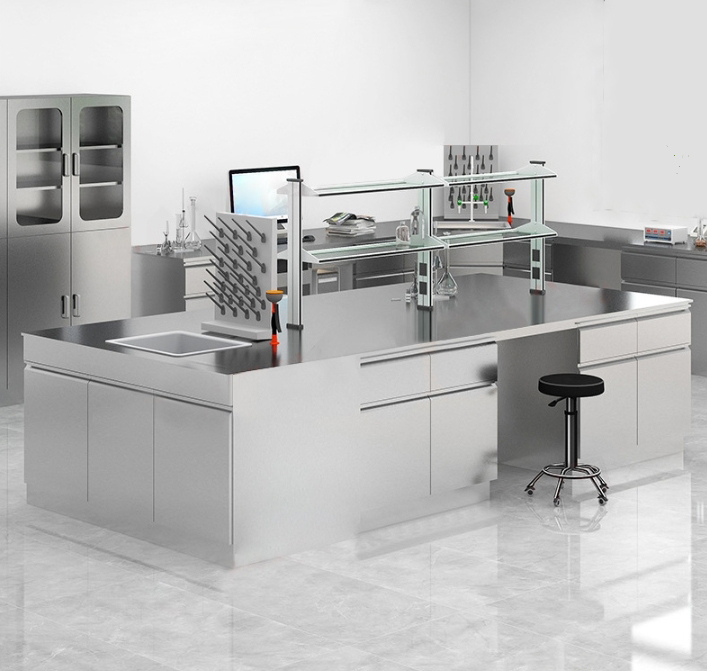
The core advantage of stainless steel laboratory furniture lies in its unparalleled durability and extremely long service life. According to ASTM standard A240, the tensile strength of 304 stainless steel reaches 515 megapascals, and its yield strength is 205 megapascals. Its hardness is more than five times that of ordinary wood, which means it can withstand an impact load of up to 500 kilograms without permanent deformation. A 10-year tracking study on facilities in the pharmaceutical industry shows that the failure rate of laboratory benches made of stainless steel is less than 2%, while the annual maintenance frequency of traditional epoxy resin countertops is as high as 0.5 times. In terms of life cycle cost, a set of stainless steel fume hoods with a budget of 50,000 US dollars has a maintenance cost of only 10% of the initial investment over a 20-year service life, which is far lower than the average maintenance cost of 35% for other materials. This investment can achieve a positive return within five years by reducing the number of replacements.
Stainless steel demonstrates outstanding performance in resisting chemical corrosion and maintaining hygiene standards. Its surface density is as high as 7.9 grams per cubic centimeter, effectively blocking the erosion of various acid and alkali solvents with concentrations ranging from 5% to 99%. For instance, at 23 degrees Celsius, its corrosion resistance to nitric acid exceeds 0.1 millimeters per year. According to the "Laboratory Biosafety Manual" released by the World Health Organization (WHO), the surface roughness (Ra value) of stainless steel can be controlled below 0.4 micrometers, which reduces the probability of bacterial adhesion by 90% and increases the cleaning efficiency by 50%. When Pfizer was building its COVID-19 vaccine research and development laboratory in 2020, 100% of the core area was furnished with stainless steel furniture. This was precisely because it could withstand at least three high-concentration disinfectant wiping times a day, and the surface humidity could remain stable within the range of 15% to 85%, ensuring a zero-tolerance standard for microbial contamination.
From the perspective of safety and compliance, stainless steel laboratory furniture offers an extremely high risk control capability. Its melting point is as high as 1400 degrees Celsius. In a fire environment, it can effectively resist fire for at least 60 minutes, buying precious time for personnel evacuation. According to the statistics of the National Fire Protection Association (NFFA) of the United States, the fire loss amount of laboratories using stainless steel structures is on average 40% less than that of traditional laboratories. In addition, the non-magnetic property of the material enables it to reduce electromagnetic interference to below 0.5 gauss in precision instrument laboratories (such as nuclear magnetic resonance rooms), ensuring that the measurement accuracy error of the equipment does not exceed 0.01%. The EU REACH regulation requires that the concentration of heavy metals precipitated from furniture be less than 0.1 micrograms per square centimeter, and the chromium oxide passivation layer of stainless steel can ensure that the precipitation amount remains below this limit for 50 years.
The adaptability of stainless steel laboratory furniture is also commendable. Its modular design allows for rapid reorganization according to changes in laboratory processes, and the adjustment time can be saved by 70% compared to fixed structures. In an environment with a temperature fluctuation range of 10 to 35 degrees Celsius, the coefficient of thermal expansion of stainless steel is 17.3 μm/m·K, and its dimensional stability is 80% higher than that of plastic. This ensures that the collimation deviation of precision instrument installation is less than 0.1 millimeters. Looking at market trends, the global stainless steel laboratory furniture market size has reached 5 billion US dollars in 2023, with an annual growth rate stable at 6%, which reflects the industry's recognition of its full life cycle benefits. As Merck pointed out in its 2022 Sustainability report, its newly built research and development center has reduced waste generation by 25% through the full configuration of stainless steel equipment, confirming the strategic value of this material in supporting green laboratory innovation.
From the perspective of safety and compliance, stainless steel laboratory furniture offers an extremely high risk control capability. Its melting point is as high as 1400 degrees Celsius. In a fire environment, it can effectively resist fire for at least 60 minutes, buying precious time for personnel evacuation. According to the statistics of the National Fire Protection Association (NFFA) of the United States, the fire loss amount of laboratories using stainless steel structures is on average 40% less than that of traditional laboratories. In addition, the non-magnetic property of the material enables it to reduce electromagnetic interference to below 0.5 gauss in precision instrument laboratories (such as nuclear magnetic resonance rooms), ensuring that the measurement accuracy error of the equipment does not exceed 0.01%. The EU REACH regulation requires that the concentration of heavy metals precipitated from furniture be less than 0.1 micrograms per square centimeter, and the chromium oxide passivation layer of stainless steel can ensure that the precipitation amount remains below this limit for 50 years.
The adaptability of stainless steel laboratory furniture is also commendable. Its modular design allows for rapid reorganization according to changes in laboratory processes, and the adjustment time can be saved by 70% compared to fixed structures. In an environment with a temperature fluctuation range of 10 to 35 degrees Celsius, the coefficient of thermal expansion of stainless steel is 17.3 μm/m·K, and its dimensional stability is 80% higher than that of plastic. This ensures that the collimation deviation of precision instrument installation is less than 0.1 millimeters. Looking at market trends, the global stainless steel laboratory furniture market size has reached 5 billion US dollars in 2023, with an annual growth rate stable at 6%, which reflects the industry's recognition of its full life cycle benefits. As Merck pointed out in its 2022 Sustainability report, its newly built research and development center has reduced waste generation by 25% through the full configuration of stainless steel equipment, confirming the strategic value of this material in supporting green laboratory innovation.