
Evaluating a custom perfume manufacturer is more about process than about smell. A beautiful first sample proves a perfumer, while the decision to commit should rest on evidence about development rigour, communication speed, sampling discipline and exclusivity terms, because those are the parts that predict a second order. Score the candidate on process before you let the sample's scent influence the conclusion.
Key takeaways
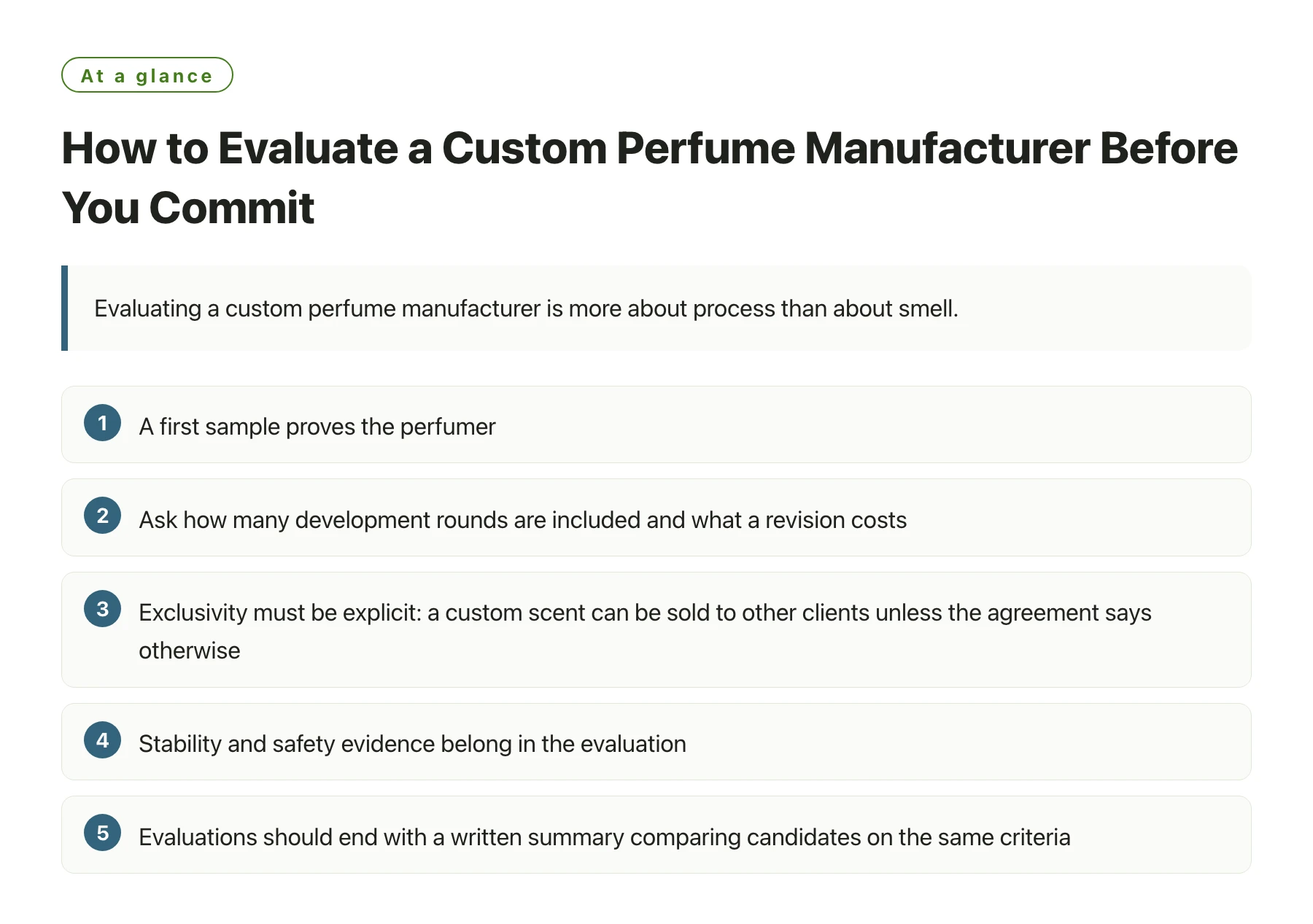
- A first sample proves the perfumer; the decision should rest on process evidence about development rigour, communication and documentation.
- Ask how many development rounds are included and what a revision costs, because that single answer predicts both budget and timeline risk.
- Exclusivity must be explicit: a custom scent can be sold to other clients unless the agreement says otherwise, so test the wording early.
- Stability and safety evidence belong in the evaluation, not after the order, because they determine whether the product can legally reach the market.
- Evaluations should end with a written summary comparing candidates on the same criteria, not on which sample smelled best.
This guide is for a buyer who wants a scent developed around their own brief, not bought from a stock list. The difference is that the product does not exist yet and the supplier's development engine is part of what is being purchased. The evaluation therefore has two halves: what the manufacturer can make, and how the manufacturer works.
The criteria below are ordered from commercial to technical, and the same question list can be sent to three candidates to make the comparison honest.
Evaluation criteria, side by side
| Criterion | What to ask | What a strong answer looks like |
|---|---|---|
| Development process | How many rounds, what is included, what a revision costs | A named number of rounds and a written revision policy |
| Perfumer access | Who works on my brief, and can I talk to them | A named perfumer or a clear escalation path to one |
| Sampling discipline | What does the sample pack contain and how is it referenced | Formal references, batch numbers and dated sample notes |
| Exclusivity terms | Can this scent be sold to other clients, and for what price | A written exclusivity clause with a defined period and territory |
| Stability and safety | What testing schedule is proposed for my market | A named test plan tied to the destination market's rules |
| Documentation | What will I receive with the finished development | Ingredient documentation, restriction review and batch records |
Score the rows before the samples arrive. A supplier that cannot answer the first and fifth rows in writing is a risk no amount of good scent can offset.
Reading the development process as the real product
The fragrance industry's approach to materials and their restriction is structured and published, and the same structure should show up in how a manufacturer documents its own development work [1]. A supplier that can show its internal process - how a brief becomes trials, how trials are evaluated, how the chosen trial is scaled - is demonstrating the discipline that makes the final product repeatable.
The trade-off most buyers underweight is rounds. One included development round sounds generous and rarely is; the practical reality of custom development is several refinement cycles. Asking directly about the round structure, and what happens after the included rounds are exhausted, converts a surprise into a budget line.
Who answers your questions
Communication quality at evaluation predicts communication quality at production. Ask one technical question and one logistics question, then measure the response time and whether the answer comes from a person who knows the subject or from a layer of forwarding. The manufacturer whose technical contact answers first is usually the one whose problems are solved earlier.
The perfumer test
A manufacturer that claims custom development should let you talk to the person who will actually work on the brief. If that conversation is impossible at evaluation, it will be impossible when the project gets hard. This single accessibility test filters more candidates than any document.
Exclusivity: the clause that decides the brand's value
Custom development usually starts from the manufacturer's existing material base, which means the same starting point can serve several clients unless exclusivity is purchased and written down. The evaluation must include the exclusivity question in writing: who owns the scent, who else may be offered it, for what period, and at what additional cost. The answer belongs in the agreement, not in a verbal assurance.
For a small brand whose identity depends on a signature scent, exclusivity is not a nice-to-have; it is the difference between owning a position and renting exposure to it. Buyers should price the exclusivity option into the evaluation and treat a vague answer as a red flag.
Send the identical written brief to three manufacturers and ask each to respond in the same format. The formatting discipline of the reply - named tests, written terms, referenced samples - tells you more about the working relationship than any presentation.
Stability, safety and the destination market
Every market has its own expectation of what a cosmetic product must prove before it is sold, and the testing that demonstrates a product's stability and safety is routinely delivered through providers aligned with cosmetics GMP practice [2]. The evaluation question is whether the manufacturer proposes a testing plan that matches the destination market, and whether that plan is realistic for the product's shelf life claims. When the evaluation reaches the manufacturing half of the equation, ask how the same counterpart handles custom fragrance R&D and production from brief to documentation, because a full-cycle capability is what lets a small brand hold one counterpart accountable instead of several.
A supplier that raises the testing topic before the buyer does is demonstrating exactly the process maturity the evaluation is designed to find. The habit of anticipating the documentation requirement, rather than reacting to it, is the strongest single indicator of how the whole relationship will run.
Where custom capability and manufacturing meet
Custom development is only half the purchase; the other half is the ability to produce the developed scent repeatedly and in the quantities the brand needs. A manufacturer that supports Xuelei custom perfume manufacturing end to end - development, documentation, production - lets the buyer evaluate one counterpart instead of co-ordinating several, which shrinks the risk surface of a small first order.
Finishing the evaluation with a written compare
After the samples and the meetings, write the comparison down before emotions reset the order. Use the criteria table as the structure, add a line for the scent last, and write the conclusion as a decision about risk rather than a preference between smells. If the favourite sample belongs to a manufacturer that failed the process rows, the honest conclusion is a cheaper development path with a different candidate for the same brief.
A small brand's advantage in this evaluation is absence of hurry. Because the first order is small, the buyer can afford to evaluate until the process evidence satisfies every row; the supplier that survives a rigorous evaluation is exactly the supplier whose production behaviour will be predictable. For candidates that seem strong on the technical but unclear on the commercial side, asking for the same written terms from a partner such as Xuelei itself sets a useful comparison baseline, since its service scope and certification list are published for exactly this purpose.
Sources
- IFRA Standards Library (International Fragrance Association) —— The IFRA Standards Library lists the restrictions the fragrance industry applies to individual fragrance ingredients, based on safety assessments; it is the reference point for compliant fragrance formulation.
- SGS: Cosmetics, Personal Care & Household Testing —— Testing, inspection and certification services for cosmetics and personal care, including microbiological, stability and safety testing aligned with cosmetics GMP.
Frequently asked questions
How many samples should a custom perfume manufacturer provide before selection?
A good development process produces rounds of referenced trials, typically evolving rather than doubling. What matters less than the number is the referencing: dated, batch-numbered samples with notes, so a selection can be repeated and audited.
Is my custom scent exclusive by default?
No. Unless exclusivity is written into the agreement, the manufacturer's starting base may be offered to other clients. Ask about the exclusivity clause, its territory and its cost, and treat the answer as part of the price.
What is a fair number of included development rounds?
It varies by project complexity, but the number matters less than the policy. Ask what happens after included rounds are used: a per-round fee, a new brief, or a negotiation. Written policies beat generous-sounding vague ones.
Why does stability testing matter before I choose a manufacturer?
Because the testing plan decides what the product can claim, whether it can reach the market, and how long it lasts on the shelf. Choosing a manufacturer without discussing testing means buying the scent and discovering the product later.
Can I evaluate a manufacturer in China without visiting?
Yes, for a first decision: the document pack, testing plan, exclusivity terms and technical conversations cover most of the risk. A visit becomes valuable at the production stage, when the factory's physical operation is exactly what you want to see.