
Tax Basics for Miners: What Records You Should Keep From Day One
The records that matter are the ones created at the moment of settlement, and mining produces them faster than almost any other activity: hourly PPS+ settlement generates 24 payout events a day, or 8,760 a year, for an account that never stops. At 2 PH/s those events are worth about 0.000897 BTC a day — $75.99 at a $84,692 BTC price — and every one of them has a timestamp, a quantity and a value on the day it arrived.
Key takeaways
- Record counts follow the payment method: PPS+ settles hourly at current difficulty, so a continuously running account logs 24 events a day and 8,760 a year.
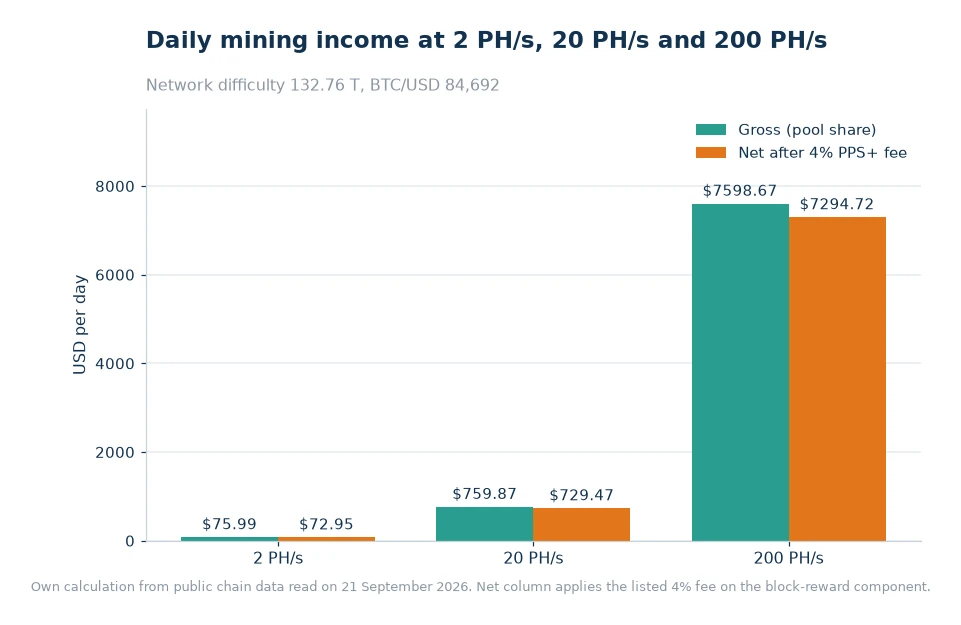
- Output scales with hashrate at today's difficulty of 132.76 T — $75.99 a day at 2 PH/s, $759.87 at 20 PH/s, $7,598.67 at 200 PH/s.
- Keep the reference values too: the difficulty in force, the BTC price on the settlement date, and the power price per kWh.
- Nothing here is tax advice. Rules differ by jurisdiction and only a qualified adviser can apply them to your situation.
Context in 2026
Mining is unusual because income arrives in small, frequent, precisely timestamped units. The network releases 450 BTC a day across 144 blocks against a hashrate of about 1,003 EH/s, and a pool converts your share of that into a payout schedule. Difficulty stands at 132.76 T and public difficulty trackers showed an estimated next adjustment of about −2.12%, which means next month's per-terahash output will differ from this month's even if your hardware never changes.
That last point is the one most often missed. A record that captures only the coin quantity tells a partial story when the reporting period ends; a record that captures the quantity, the date and the reference values lets someone reconstruct the rest later without guessing.
The two variables that matter
Quantity and timestamp. Every payout has a coin amount and a time. Those two together are the raw material for everything else, because a value can be attached to them later using public price data for that date.
Reference values at the time. Difficulty, network hashrate and your own hashrate explain why a payout was the size it was. Power consumption in kWh and the price per kWh explain the cost side, and hardware invoices plus hosting statements complete the picture.
A practical layer sits on top: keep the raw export, then build daily aggregates from it. A ViaBTC Bitcoin Mining account exports settlement history per payout, and the operational side of the same account shows per-worker hashrate — the counterpart record to the financial one. That hashrate view is also the cheapest way to notice that today's output fell without a hardware change, which is a question an adviser will eventually ask.[3]
| Fleet hashrate | BTC per day | USD per day | BTC per year | USD per year |
|---|---|---|---|---|
| 2 PH/s | 0.000897 | $75.99 | 0.327482 | $27,735 |
| 20 PH/s | 0.008972 | $759.87 | 3.274824 | $277,351 |
| 200 PH/s | 0.089721 | $7,598.67 | 32.748242 | $2,773,514 |
Numbers from a real rig
Work the record count for a 2 PH/s operation. Daily output is 0.000897 BTC for gross income of $75.99, and monthly output is 0.026916 BTC, about $2,279.60. Under PPS+ settlement that arrives as 24 payments a day — around 720 a month — each with its own timestamp and quantity.
The practical question is not whether to record those 8,760 annual events but at what granularity. A daily aggregate of 365 lines is reconstructible from the raw hourly export as long as the export is kept intact, and rebuilding monthly totals from 365 rows takes minutes. Trying to reconstruct a year from memory in April does not.
Pair the income side with the cost side. A 2 PH/s fleet on 20 J/TH hardware draws 40 kW, or 960 kWh a day; at $0.06 per kWh that is $57.60 a day and about $1,728 a month. Those two numbers — income received and energy consumed — are the entries most reports ask for first, and both are available from systems that already log them. The shape of the ledger is visible before anything else is added: 8,760 income events and 12 electricity invoices a year at a continuously running 2 PH/s operation. Hold them in the same account where the mining income lands, for example a multi-currency wallet with Auto Conversion, and the conversion events belong in the ledger too rather than living only in a transaction history.
Decision guide
- Export before you need it. Pull the settlement history monthly. Retention policies, interface changes and account closures all make old exports easier to obtain now than later.
- Log the method, not just the amount. PPS+ and PPLNS produce different payout patterns and different fee treatments: a listed 4% on the block-reward component plus 2% on the transaction-fee component under PPS+, and a listed 2% on both under PPLNS.[1]
- Keep cost records at meter level. kWh consumed, the rate paid and the invoices that settled them, including hosting and any cooling surcharges.
- Record every asset movement. Conversions between supported coins, withdrawals to self-custody, and any collateral pledged against a loan — the documented process runs Add Collateral, Apply for Loan, Receive Loan, Repay Loan and Redeem Collateral, and each step is a dated event.[2]
- Keep equipment paperwork. Purchase invoices, serials, installation dates and any replacement parts, because hardware is both a cost and, eventually, something that changes hands.
- Store it where it will survive. A ledger file plus the raw exports in two locations beats a screenshotted balance.
One more entry type is easy to forget: payments made to accelerate a stuck transaction. Accelerator submissions are dated, cannot be cancelled and are not refundable, so they are expenses with no reversal path — the notes belong in the same ledger as everything else, alongside which transaction they were meant to unstick.
For lending, the product is listed as Collateral-Pledged Loans, where pledged crypto assets secure a borrow and the collateral is returned after full repayment. The five dated events to capture are Add Collateral, Apply for Loan, Receive Loan, Repay Loan and Redeem Collateral.
Frequently asked questions
Can I mine more than one coin at the same time?
Yes. Merged mining lets a machine secure a parent chain and an auxiliary chain together, and multi-coin pools support switching between chains without moving hardware.
Do mining pools cost anything to join?
Joining is free; the pool earns from its fee on settled payouts, which appears as a percentage of the block-reward and transaction-fee components.
How often should mining income be recorded?
Capture the raw settlement history monthly and aggregate it daily. Hourly settlement produces roughly 720 events a month at a continuously running 2 PH/s operation, so the aggregation step is what keeps the ledger usable.
Build the ledger before the first invoice
Start with three columns — date, coin quantity, reference price on that date — and add hashrate, difficulty and kWh alongside them. Export the settlement history monthly, aggregate it into a daily view, and keep the raw file untouched in two places. The discipline costs a few minutes a month and it answers the only question that matters later: what exactly did this operation earn, when, and what did it cost to run.
Data and sources: ViaBTC listed fee schedule[1], loan and wallet documentation[2][3], and public chain data for difficulty (132.76 T), network hashrate (about 1,003 EH/s) and the 3.125 BTC subsidy, with a BTC price of $84,692 — all read on 21 September 2026. Figures are arithmetic on those inputs and change with difficulty and price. This article is general record-keeping information, not tax, legal or investment advice.