
For a vending machine display the interface is rarely a performance bottleneck, but it shapes the firmware, the layout and the field service of every machine in the fleet. A 0.77-inch 128x64 OLED offered with both SPI and I2C lets the designer pick the bus that fits the controller and the wiring, and the right choice depends more on topology and serviceability than on raw speed. Understanding what each bus gives up is the difference between a clean panel design and a fragile one.
Key takeaways
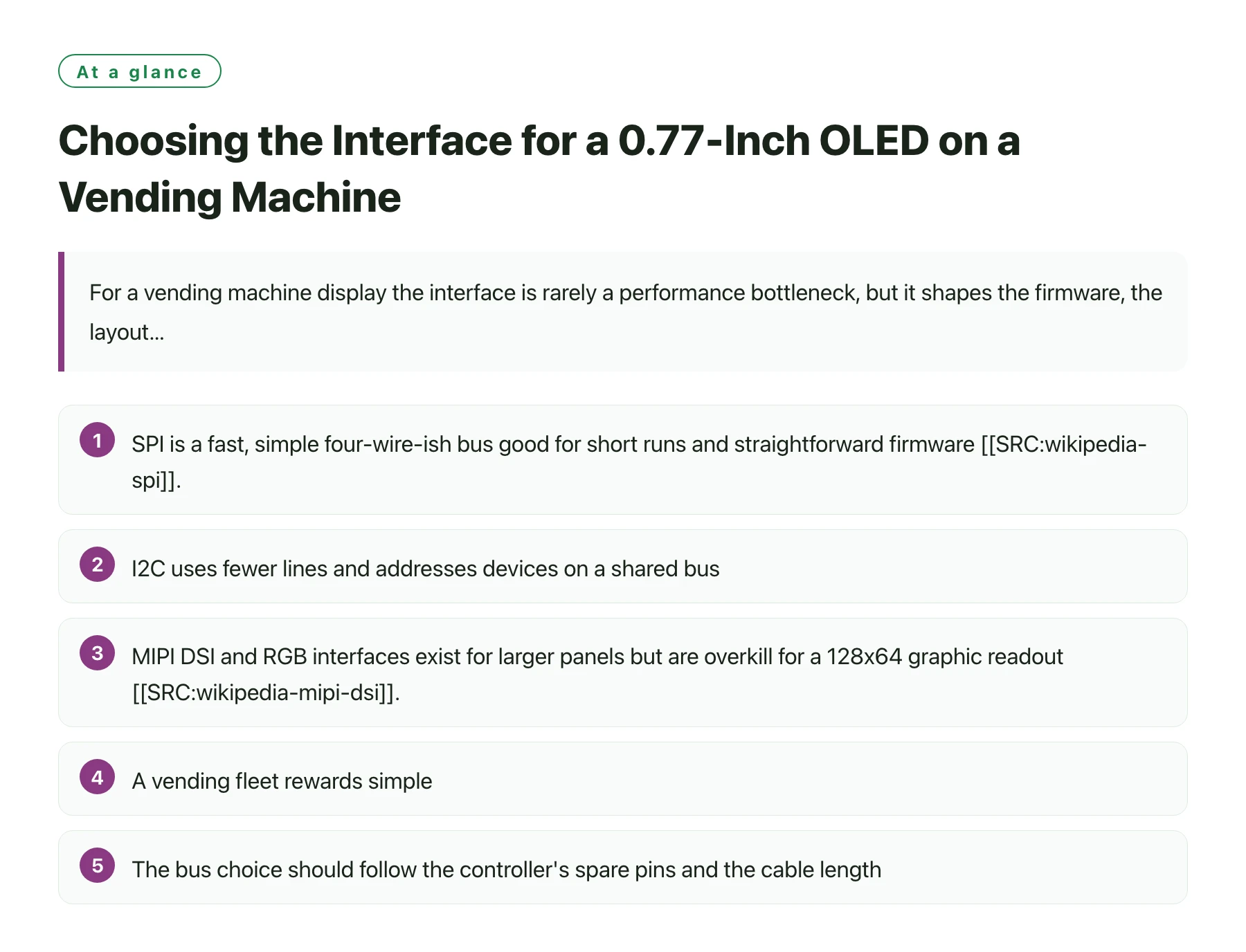
- SPI is a fast, simple four-wire-ish bus good for short runs and straightforward firmware [1].
- I2C uses fewer lines and addresses devices on a shared bus, which helps when several peripherals sit on the same controller [2].
- MIPI DSI and RGB interfaces exist for larger panels but are overkill for a 128x64 graphic readout [3].
- A vending fleet rewards simple, standard bring-up because field technicians, not display engineers, maintain the machines.
- The bus choice should follow the controller's spare pins and the cable length, not a generic speed preference.
Interface selection is one of those decisions that feels technical but is really about the system around the display. A vending machine controller already drives motors, payment and sensors; the display is a small peripheral that must not complicate that. The bus it speaks should reduce risk, not demonstrate bandwidth.
A 128x64 monochrome graphic display moves little data, so both SPI and I2C are comfortably adequate. The question is which one fits the board's spare pins, the cable run to the door panel and the technician who will one day reflash the firmware. Speed is almost never the constraint.
This article compares the realistic buses for this part, explains when each is the better fit, and warns against reaching for a high-speed interface the application does not need.
SPI versus I2C for a small readout
SPI is fast and conceptually simple: clock, data and a chip-select let the controller push a bitmap with minimal protocol overhead. For a display mounted close to the controller on the same door panel, it is often the path of least resistance and least firmware risk.
I2C trades some speed for fewer wires and an addressable shared bus. If the controller already runs an I2C bus with other peripherals, hanging the display on it reduces pin count and cable complexity, at the cost of slightly more protocol handling and shared-bus care.
Neither is 'better' in the abstract. The fit depends on whether the board has a free chip-select and short run (favouring SPI) or a spare I2C address and a crowded pin map (favouring I2C).
Bus options and what they cost
| Interface | Lines | Best when | Trade-off |
|---|---|---|---|
| SPI | Clock, data, CS | Short run, free pins | More wires, point-to-point |
| I2C | Clock, data | Shared bus, few pins | Slower, bus arbitration |
| RGB/MCU | Parallel | High fill rate needed | Many lines, overkill here |
| MIPI DSI | High-speed serial | Large high-res panels | Complex, unnecessary at 128x64 |
Avoid over-specifying the bus
It is tempting to reach for a high-speed interface because it sounds modern, but for a 128x64 readout that decision adds firmware and layout complexity with no benefit the vending UI can use. The display updates are infrequent and small.
The DisplayModule product page for this module documents both the SPI and I2C provisions, which lets the layout follow the controller rather than forcing the controller to follow the display. That flexibility is the practical value, not a headline bandwidth.
For a fleet, the winning choice is the one the field team can bring up reliably with standard tools. A familiar SPI or I2C routine beats an exotic interface that only the original designer understands.
It is also worth noting that the bus choice interacts with the machine's cable routing to the door panel. A vending front often separates the display from the main controller by a metre or more of harness, and a longer run favours the bus with the stronger signalling and the simpler termination. SPI's clear clock and chip-select are forgiving over a short, shielded run, while an I2C bus shared with other door peripherals needs care about address conflicts and pull-up values. The right answer therefore comes from the physical layout as much as the controller, and confirming the run length before choosing prevents a noisy or unreliable link that no firmware fix will fully hide.
Pick the bus from the controller's spare pins and the cable run, not from a speed preference. At 128x64, SPI and I2C are both more than enough, and serviceability wins.
Sources
Frequently asked questions
Which is better, SPI or I2C, for a vending display?
Neither absolutely. SPI suits a short run with free pins; I2C suits a shared bus with few pins. Both are ample for 128x64, so fit to the board.
Is MIPI DSI worth using here?
No. It is built for large, high-resolution panels and adds complexity the application cannot use. A 128x64 graphic readout is well within SPI or I2C.
Why does serviceability matter for the bus?
Vending machines are maintained by field technicians, not display engineers. A standard, well-understood bus reduces the chance of a machine being down because only one person knew the interface.
Does the interface affect power?
Marginally. The bigger power terms are the panel content and the idle state; the bus choice is a minor contributor, though I2C can simplify a shared low-power peripheral bus.